Questions about shared air
Ask in writing when possible and keep the answers.
- Does each unit have its own heating and cooling system, or is air shared?
- Where does corridor air enter and leave the building?
- Do bathroom and kitchen exhausts share a vertical shaft with other units?
- Is there a makeup air system, and which units does it serve?
- When were filters last replaced in common systems?
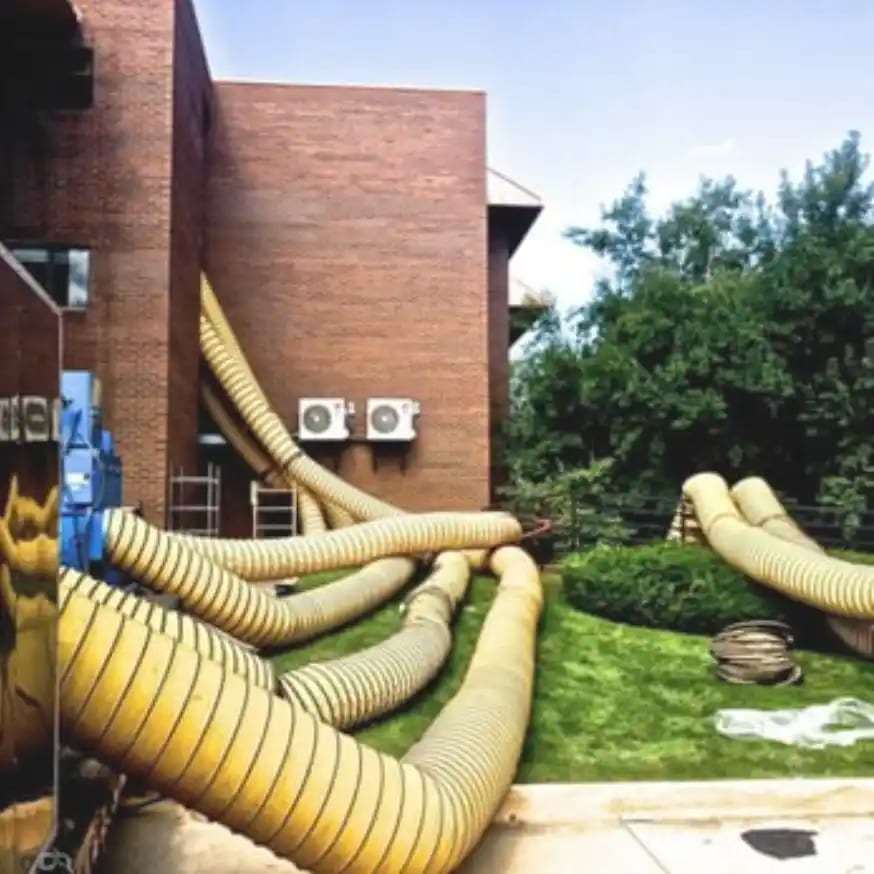
Large drying ducts running from a trailer into a brick building. Shown to illustrate the work described; not a job for this site or at any address named here.
Why these questions matter
Many newer RiNo buildings are tightly sealed for energy efficiency. A sealed building keeps heat in but also keeps odors circulating, and corridors that are pressurized or depressurized can push air in or out of units. A manager who knows the airflow plan can tell you whether your unit is likely to receive air from a neighbor.
Do not expect a manager to give engineering details instantly. Ask for the contact of the mechanical contractor or the building's plans if a conversation is needed. The point is to have specific facts on record rather than vague descriptions.
Bring a short written summary to any meeting, since verbal conversations are easy to forget and hard to prove later. Include the dates, the rooms affected and the tests you ran. A one-page summary also makes it simpler for a busy manager to forward to an engineer or board member.
A sequence for the conversation
- First message
- Describe the odor, dates and times, and ask for the ventilation basics.
- Follow up in one week
- Share your log and ask if anyone has checked airflow.
- If unresolved
- Ask for a written response and the next step the association will take.
- After that
- Consider asking an independent professional to assess air movement.
If the answers are unclear
Managers may not know the answers immediately, and that is normal in an older warehouse conversion where systems were retrofitted. Ask who does know, such as the mechanical contractor or the association's engineer, and request a date by which you will hear back.
Record every reply with date and sender. If odor continues and the building cannot explain the airflow, an independent assessment of air movement can add facts without assigning blame to any resident.
What to bring to the first conversation
Common questions
Can a manager share a neighbor's information?
Usually not, but they can say what steps they have taken and what they plan to do.
General information for RiNo, not a quote or professional advice. In an emergency, call 911.