Stratification in plain terms
Warm air rises and cool air sinks, so tall rooms develop layers: the air near the ceiling can be several degrees warmer than the air at the floor, especially in winter when the heat is running and in summer when sun pours through big warehouse windows. Smoke leaves a joint or cigarette hot, rises quickly, and spreads out along the top of the room. It does not mix evenly the way it would in a standard eight-foot apartment.
That upper layer is where residue lands: on the ceiling deck, the tops of beams, exposed ducts, pendant lights, track lighting, the upper section of brick walls and the top of tall windows. Because people rarely clean above head height, it can build for years. When the room warms, the upper surfaces release odor back into the warm air, which eventually circulates down. Occupants smell it most on a hot afternoon or the first evening the furnace kicks on in the fall.
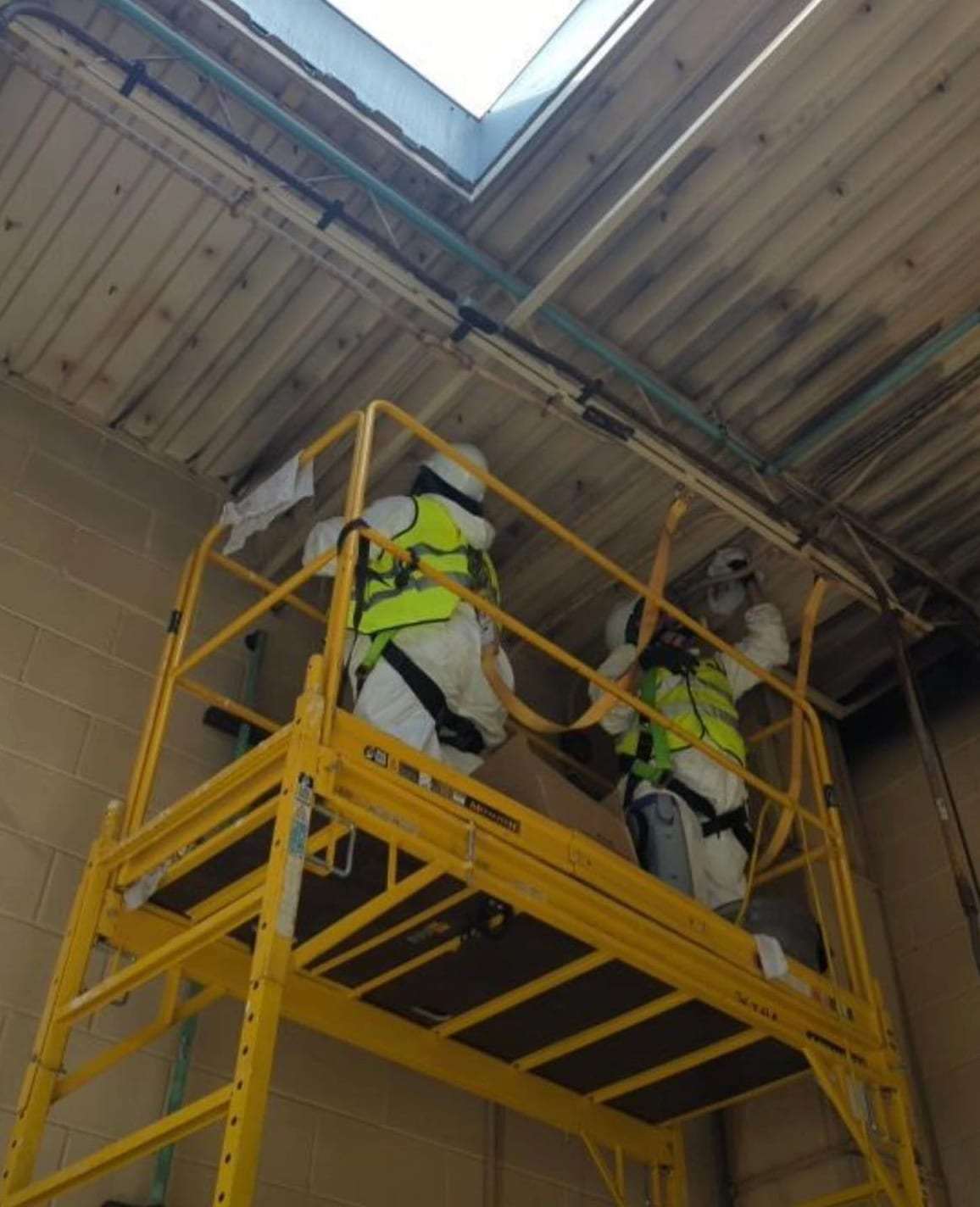
Technicians in protective suits on scaffolding cleaning a high ceiling. Illustrative only: this photo is not from a job tied to this site or a specific address.
Getting to the top layer safely
This is the part most do-it-yourself cleanups skip.
- Check the high surfaces first.From a stable platform ladder, wipe a white cloth on the top of a beam, a pendant light shade and the upper corner of a window frame. Compare the cloth with one wiped at waist height.
- Plan access.Extension poles with flat mop heads reach many ceilings. For very tall spaces, a rolling scaffold or a lift may be needed. Do not stand on furniture or the top step of a ladder.
- Protect what is below.Cover floors, furniture and electronics. Residue loosened from above drips and falls.
- Clean from the top down.Ceiling first, then beams and ducts, then upper walls and windows, then lower surfaces. Cleaning in the other order just re-soils what you finished.
- Run ceiling fans to mix the air afterward.A slow ceiling fan reduces stratification day to day, which helps any remaining odor disperse rather than concentrate in a warm layer up top.
High places that are easy to miss
- Tops of beams and ducts
- Flat upper surfaces collect dust bonded to residue
- Pendant and track lights
- Warm fixtures bake film onto shades and housings
- Clerestory and transom windows
- Upper glass and frames hold tacky haze
- Ceiling fan blades
- Both sides, especially the leading edge
- Smoke detectors and sprinkler heads
- Do not clean with liquids or coat; ask building maintenance
General information for RiNo, not a quote or professional advice. In an emergency, call 911.